
thumbnail image
    Request Early Access
      Request Early Access
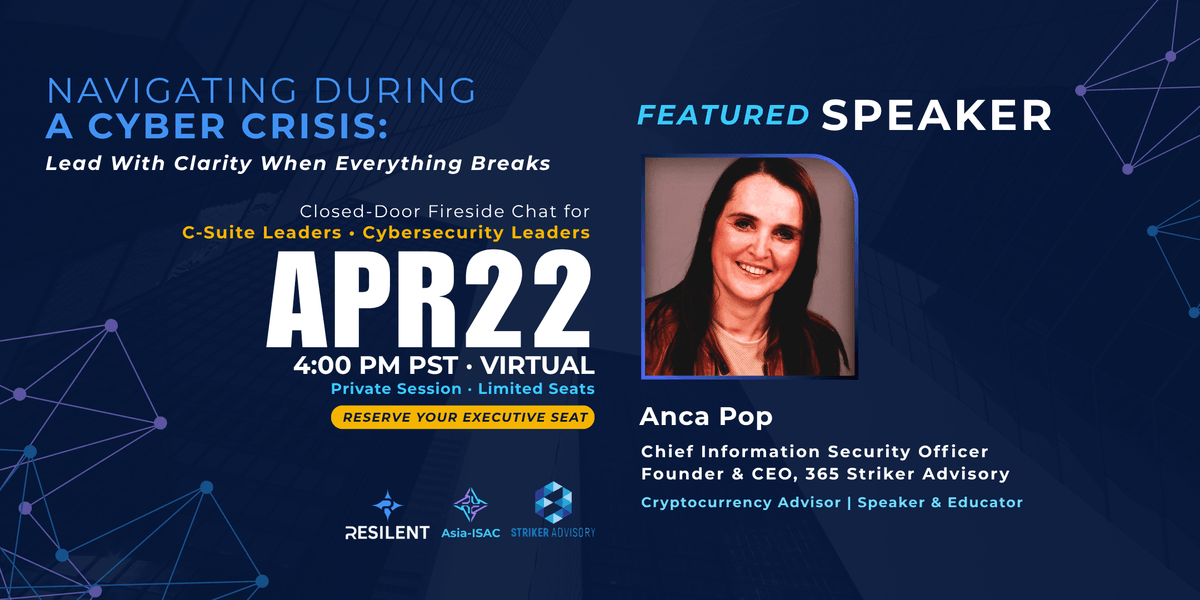
      • Navigating During a Cyber Crisis:

        Lead With Clarity When Everything Breaks.

        A closed-door executive conversation exploring how leadership, clear communication, and coordinated decision-making help organizations navigate cyber crises, manage uncertainty, and strengthen resilience when critical operations are at risk.
        Explore Upcoming Events
      • 22 April 2026 | 4:00 PM PST | 1 Hour | Zoom

      • Why This Conversation Matters

        1

        In high-stakes moments, leadership clarity stabilises organisations faster than technical containment alone.

        2

        Confusion at the executive level amplifies operational damage and reputational risk.

        3

        Effective crisis leadership protects trust across customers, regulators, and employees.

      • Key Discussion Topics

        1

        Executive communication principles for leading cross-functional response teams.

        2

        A structured approach to decision-making when information is incomplete or rapidly changing.

        3

        Methods to align technical response with business priorities in real time.

      • Featured Speaker

        Section image

        Anca Pop

        Chief Information Security Officer | Founder & CEO, 365 Striker Advisory | Cryptocurrency Advisor | Speaker & Educator

        She brings a business-focused perspective to cybersecurity, information security, and enterprise risk. Her work explores how organizations can strengthen cyber preparedness, navigate uncertainty, and make informed decisions during a crisis. By connecting technical challenges with business priorities, she highlights the importance of clear communication, effective response strategies, and organizational resilience when critical systems and business operations are at risk.

      • Hosted by

        Section image

        James Cruz

        Founder & CEO, Resilent

        25+ years of global leadership experience across Fortune 100 companies and technology startups, including Microsoft, HP, and Procter & Gamble. A cybersecurity architect and program leader, he has led global initiatives across Asia, Europe, and the US. James is passionate about technology, AI, cybersecurity, people, and business scaling.

        Section image

        Steve Landes

        Author, Rehumanizing Trust | Trust Architect | CISSP | MBA |

        Advisor on Trust, Risk & Organizational Blind Spots

        A seasoned cybersecurity leader and systems strategist with more than a decade of experience across cyber threat intelligence, strategic analysis, and executive engagement in healthcare, finance, and national security. A Certified Information Systems Security Professional (CISSP) with an MBA in Strategic Thinking, Steve combines technical expertise, strategic insight, and human understanding to advance digital trust, cyber resilience, and systemic change.

      • Who It’s For

        This executive conversation is designed for leaders responsible for cybersecurity, crisis response, and business continuity when critical decisions must be made under pressure.

        • CEOs, CFOs, CIOs, CISOs, CTOs & CROs
        • Board Members & Directors
        • Cybersecurity, Technology, Risk & Business Leaders
        • Business Continuity & Crisis Response Professionals
        • Senior Business Leaders Responsible for Operational Resilience
      • Core Key Insights

        01

        A Plan Is Not the Same as Preparedness.

        Cyber incident response plans and tabletop exercises are only the starting point. Organizations must test their plans against realistic scenarios, expose gaps in roles and recovery processes, and measure whether their response capabilities improve over time.

        Preparedness means knowing what to do when the plan meets reality.

        02

        A Cyber Crisis Is a Business Decision.

        During an incident, technical teams need time to investigate while executives need answers. Effective response depends on clear communication, cross-functional coordination, and translating technical findings into business risks, operational impact, and informed decisions.

        When uncertainty is unavoidable, clarity and coordination matter most.

        03

        Resilience Must Be Measured, Not Assumed.

        Stronger security requires more than deploying tools or hardening systems. Organizations must invest in people, processes, and security fundamentals then measure whether exercises, awareness, and response practices are actually improving their ability to manage a crisis.

        The goal is not simply to reduce risk. It is to improve how the organization responds when risk becomes reality.

      • Ready for the Next Conversation?

        Join private executive conversations where cyber risk meets leadership.

        Reserve Your Seat | Apply to Speak
        Past Events

        Subscribe to our newsletter

        Get the latest insights on cyber resilience,

        executive decision-making, and staying ready when cyber incidents hit.
      © 2026 Resilent Pte Ltd.

      All rights reserved.

      Terms & Conditions
      Privacy Policy
        Home
        Posts
        Call Us
        Contact
      Cookie Use
      We use cookies to ensure a smooth browsing experience. By continuing we assume you accept the use of cookies.
      Learn More